
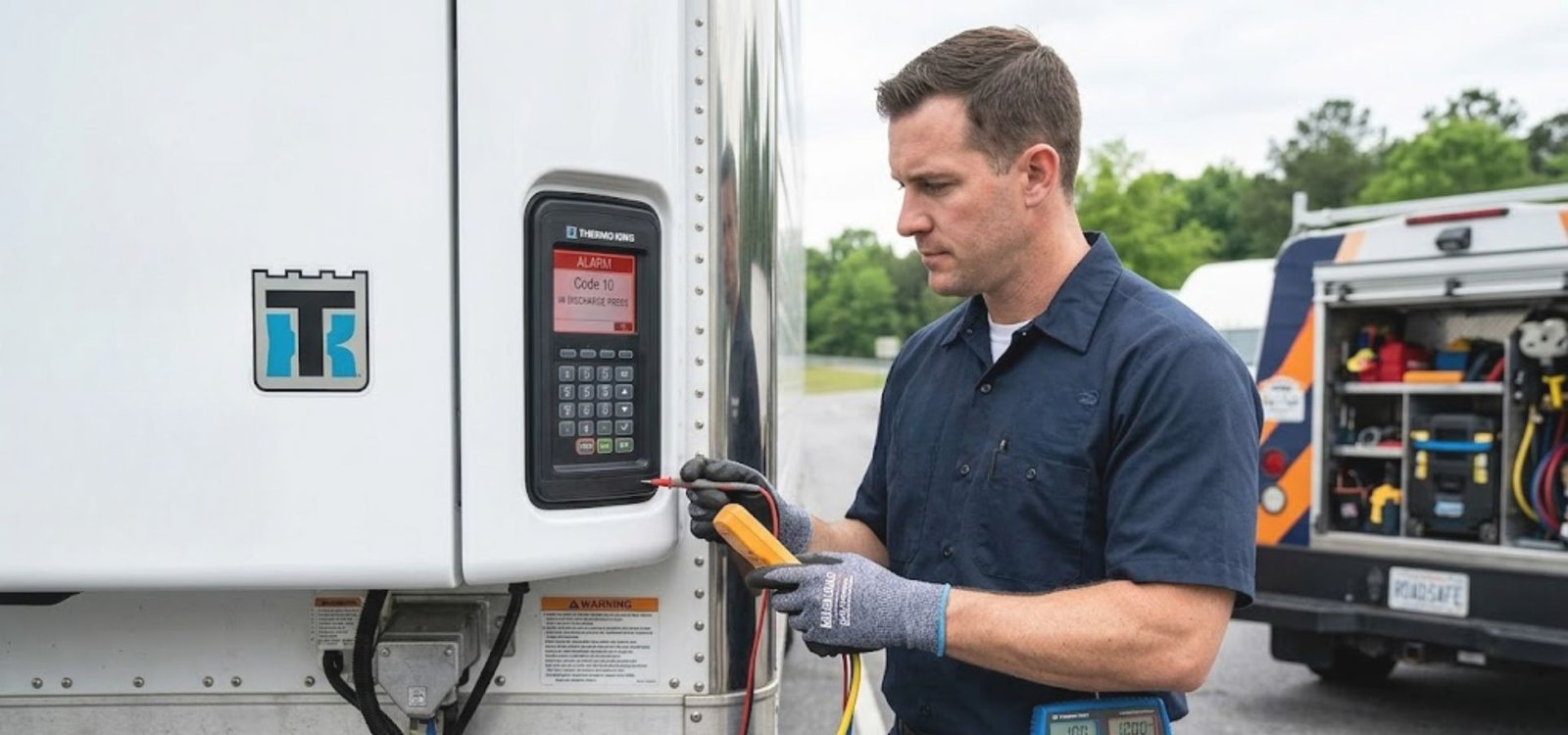
When you are hauling temperature-sensitive freight across major highway corridors, nothing triggers stress faster than a blaring alarm buzzer or a flashing warning light on your refrigeration control panel. A sudden reefer unit failure puts tens of thousands of dollars worth of fresh produce, pharmaceuticals, or frozen goods at immediate risk of spoilage.
At Road Safe, we know that every minute counts in cold chain logistics. While some severe mechanical breakdowns require professional shop equipment, many common alarm codes triggered on Thermo King and Carrier Transicold units can be identified, managed, or safely resolved right on the shoulder of the road. Understanding how to handle these alarms keeps your cargo safe and prevents costly downtime.
Understanding Reefer Alarm Code Severity
Before grabbing your toolkit, it is essential to understand how microprocessors categorize issues. Refrigeration units evaluate conditions using two primary alarm levels:
Log/Warning Alarms (Yellow Light / Check Indicator): The controller alerts you to an operational anomaly, but the unit continues to run. While cargo temperature is not immediately compromised, ignoring a warning code can quickly lead to a full system shutdown.
Shutdown Alarms (Red Light / Alarm Bell): The controller has automatically stopped the engine or compressor to protect the unit from catastrophic failure. Immediate roadside intervention is required to prevent cargo spoilage.
Common Thermo King Alarm Codes & Roadside Fixes
Thermo King controllers (including Smart Reefer SR-2, SR-3, and SR-4 models) use numeric fault codes. Here are the most frequent codes drivers encounter on long hauls and how to troubleshoot them:
1. Alarm Code 10: High Discharge Pressure
Meaning: System pressure on the high side has exceeded safe operating limits.
Primary Causes: Blocked condenser airflow, failed condenser fan, or excessive refrigerant charge.
Roadside Action: Turn off the unit. Inspect the front condenser coil for road debris, plastic bags, mud, or ice buildup. Clear all physical obstructions, wash away caked dirt with water if available, allow the system to cool for 15 minutes, clear the alarm, and restart.
2. Alarm Code 17: Engine Failed to Crank
Meaning: The starter solenoid engaged, but the reefer diesel engine failed to turn over.
Primary Causes: Weak or discharged battery, corroded cable terminals, blown main fuse, or starter fault.
Roadside Action: Inspect battery terminals for corrosion or loose connections. Clean away oxidation, tighten cable clamps, and check the blade fuses inside the control cabinet. If battery voltage reads below 12.2V, jumpstart the reefer using heavy-duty booster cables connected to your tractor’s charging system.
3. Alarm Code 20: Engine Failed to Start
Meaning: The engine cranks normally but fails to catch and run.
Primary Causes: Empty fuel tank, gelled diesel fuel in cold climates, clogged fuel filters, or air in the fuel lines.
Roadside Action: Physically verify the fuel level in the reefer tank using a dipstick or sight glass. If the tank ran dry, refill it and use the manual hand primer pump on the fuel filter housing to bleed trapped air. In sub-zero temperatures, inspect the primary fuel filter for wax gelation and add an emergency anti-gel additive.
4. Alarm Code 63: Engine Stopped – Reason Unknown
Meaning: The microprocessor detected an unexpected, sudden drop in engine RPM while running.
Primary Causes: Fuel flow restriction, heavily clogged air filter, or transient sensor disruption.
Roadside Action: Inspect the air intake screen for trapped debris. Check fuel supply lines for severe kinks or air bubbles. Reset the alarm on the controller and perform a test restart.
Common Carrier Transicold Alarm Codes & Roadside Fixes
Carrier Transicold controllers (including Vector and X4 series with APX systems) utilize alphanumeric codes starting with AL.
| Carrier Alarm | Description | Primary Cause | Roadside Troubleshooting |
|---|---|---|---|
| AL01 | Low Oil Pressure | Low engine oil level or faulty oil pressure switch | Check dipstick immediately; top off with 15W-40 diesel oil if low. |
| AL03 | High Engine Temp | Engine overheating due to coolant loss or belt slip | Check coolant level in recovery tank; inspect water pump belt tension. |
| AL13 | Low Battery Voltage | Alternator failure or battery degradation | Check alternator belt; tighten loose battery cable connections. |
| AL20 | High Discharge Pressure | Excessive head pressure from restricted airflow | Clear bugs, dirt, and road debris from the condenser grille. |
| AL22 | Evaporator Fan Safety | Fan motor overload or obstruction | Inspect evaporator housing for ice buildup or physical obstructions. |
Step-by-Step On-the-Road Troubleshooting Protocol
When an alarm triggers while driving, follow this systematic diagnostic process:
Pull Over Safely: Navigate to a rest area, truck stop, or wide shoulder. Never attempt to inspect or repair a running unit in active traffic lanes.
Document Operating Conditions: Record the setpoint, return air temperature, and supply air temperature displayed on the screen before pressing any buttons.
Access Alarm History: Navigate to the alarm menu on the controller. Write down all active codes and historical alarms to share with technicians if needed.
Conduct Visual & Physical Inspections:
Verify diesel fuel, engine oil, and coolant levels.
Check all drive belts for cracking, fraying, or loose tension.
Look inside the trailer to ensure cargo placement isn’t blocking return air bulkhead chutes.
Clear and Monitor: Reset the microprocessor alarm memory and initiate a fresh start sequence. Monitor the unit closely for 15–20 minutes. If the alarm recurs immediately, hardware repair is required.
Regional Emergency Support: When You Need Professional Service
While basic visual checks and filter maintenance can resolve minor faults, severe issues—such as compressor electrical faults, major refrigerant leaks, or internal engine component failures—require certified repair technicians.
At Road Safe, our dedicated mobile emergency reefer repair fleet operates 24/7 across Ontario’s primary shipping hubs. When roadside troubleshooting isn’t enough, our technicians provide fast, certified service across these regional corridors:
Dedicated emergency dispatch for reefer repair in Toronto covering Highway 401, 400, and 427 routes.
Rapid response mobile service for reefer repair in Mississauga near major logistics hubs and intermodal terminals.
On-site yard and highway support for reefer repair in Brampton.
Specialized transport refrigeration diagnostics for reefer repair in Oakville along the QEW corridor.
Complete mobile technician support for reefer repair in Burlington.
Strategic roadside units providing reefer repair in Milton along busy Highway 401 freight lanes.
Cold chain emergency service for reefer repair in Kitchener and surrounding industrial parks.
Expert mobile mechanics for reefer repair in Cambridge.
Comprehensive refrigeration support for reefer repair in Guelph to protect your cargo investment.
Pre-Trip Inspection Checklist to Prevent Alarm Codes
Minimizing roadside breakdowns starts before you pull out of the yard. Integrate these critical checks into every pre-trip routine:
[ ] Fluid Levels: Verify engine oil, radiator coolant, and reefer diesel tank levels before loading.
[ ] Automated Pre-Trip Test: Run the self-diagnostic cycle (
Pre-Tripon Thermo King /Functional Teston Carrier) at least 2 hours prior to pickup.[ ] Airflow Path: Ensure interior evaporator guards and floor channels are free of plastic wrap, wooden pallet debris, or ice buildup.
[ ] Door Switches & Seals: Confirm door gaskets fit tightly and verify that opening trailer doors automatically shuts down evaporator fans.
Protect Your Temperature-Sensitive Freight
Understanding reefer alarm codes gives drivers the confidence to address minor glitches quickly and protect high-value perishable cargo. When a code indicates a deeper mechanical failure, having a dependable emergency service partner keeps your operations running smoothly. Depend on Road Safe for expert, round-the-clock mobile transport refrigeration repair across Ontario.
Frequently Asked Questions (FAQs)
What types of reefer and heater units do you service across the Greater Toronto Area? ▼
We service all major brands of transport refrigeration and heating equipment, including Thermo King, Carrier Transicold.
How quickly can you reach me if my reefer fails on the highway? ▼
Our average response time across major GTA highways and logistics hubs is within 30 to 60 minutes.
Can you fix the problem on the spot, or will I need a tow to a repair shop? ▼
Over 85% of our service calls are resolved directly on-site by our fully equipped mobile service trucks.
Do you offer regular maintenance to prevent unexpected breakdowns? ▼
Yes, we provide custom scheduled preventive maintenance packages for individual owner-operators and large fleets.
Is your emergency hotline truly available twenty-four hours a day, seven days a week? ▲
Yes, our hotline is staffed twenty-four hours a day, seven days a week, three hundred and sixty-five days a year. You speak directly to a real industry professional who understands your situation and dispatches the right technician immediately.
