
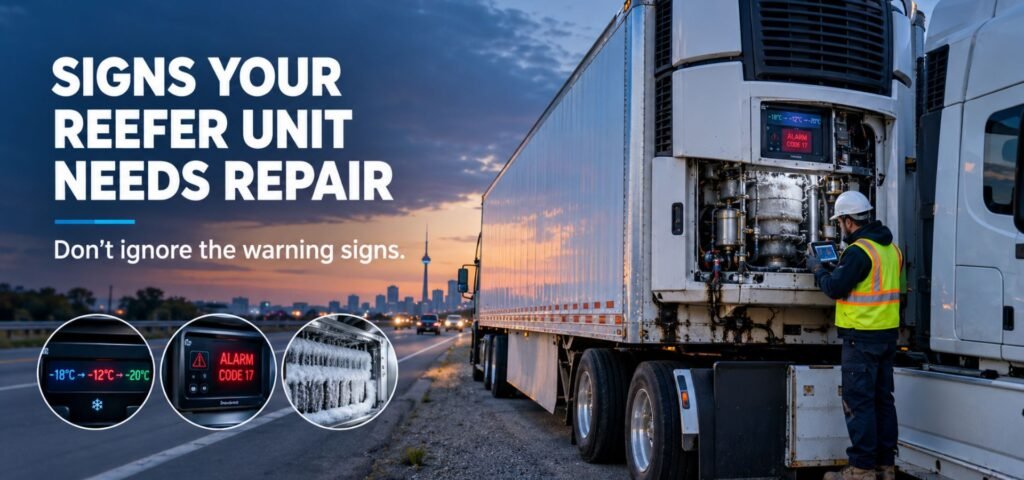
A refrigerated trailer is only as reliable as the unit that keeps it cold. When a reefer fails mid-route, the damage isn’t limited to a mechanical breakdown — it’s spoiled loads, missed delivery windows, angry customers, and insurance claims that eat into your margins. The good news is that reefer units rarely fail without warning. They almost always give you signals first. The trick is knowing what to look for, and acting on it before a small issue becomes a roadside emergency.
At Road Safe, we work with fleet owners and owner-operators every day who come to us after a breakdown that could have been prevented with an earlier inspection. Below are the warning signs every driver and fleet manager should know, so you can catch trouble before it costs you a load.
1. Inconsistent or Fluctuating Temperatures
The most obvious red flag is a reefer that can’t hold a steady setpoint. If you’re watching the temperature readout climb and dip repeatedly, even by a couple of degrees, something in the system isn’t working the way it should. This could be a failing thermostat, a refrigerant leak, a struggling compressor, or airflow that’s being blocked inside the trailer.
Temperature swings are especially dangerous with sensitive cargo like pharmaceuticals, dairy, or seafood, where even a short excursion outside the safe range can ruin an entire shipment. If your unit is cycling more than usual to maintain its setpoint, don’t wait for a full failure — get it checked.
2. Unusual Noises From the Unit
Reefer units aren’t silent, but they do have a normal operating sound. Grinding, squealing, clunking, or a high-pitched whine that wasn’t there before are all signs that something mechanical is wearing out. Common culprits include:
- A failing compressor bearing
- A loose or worn belt
- A fan motor on its way out
- Debris caught in the condenser or evaporator fan
Noise is one of the earliest indicators a unit gives you, and it’s also one of the easiest to ignore because the trailer is still running and still cooling — for now. Catching a noise issue early is almost always cheaper than waiting for the part to fail completely.
3. Excessive Frost or Ice Buildup on the Evaporator Coil
Some frost on the evaporator coil during a defrost cycle is normal. Heavy, persistent ice buildup is not. This usually points to a defrost system malfunction, low refrigerant charge, or a fan that isn’t circulating air properly across the coil. Left unaddressed, this ice buildup restricts airflow, forces the compressor to work harder, and eventually causes the unit to lose its ability to maintain temperature altogether.
4. Increased Fuel Consumption
A reefer unit that’s burning noticeably more diesel than usual is often working harder than it should to hit its target temperature. This can be caused by a dirty condenser, a refrigerant leak, worn compressor components, or a clogged air filter restricting airflow. Fuel consumption creeping up over several trips is a slow-motion warning sign — not dramatic, but expensive if ignored, and a strong indicator the unit needs a diagnostic check.
5. Longer Pull-Down Times
Pull-down time is how long it takes your unit to bring the trailer down to setpoint after loading. If you’ve noticed the unit taking longer than it used to — especially on loads that are similar to ones it’s handled before — that’s a sign of declining performance. It could be a refrigerant issue, a weakening compressor, or insulation problems in the trailer itself. Track your pull-down times over a few loads; a gradual increase is a clear signal that something is degrading.
6. Visible Refrigerant Leaks or Oily Residue
Oily residue around fittings, hoses, or the compressor housing is a telltale sign of a refrigerant leak. Refrigerant carries a small amount of oil with it, so a leak often shows up as a greasy film before you notice a temperature problem. Leaks don’t fix themselves, and low refrigerant levels force the compressor to work overtime, accelerating wear on the entire system. If you spot residue, it’s worth having a technician run a proper leak test rather than just topping off the refrigerant.
7. Error Codes or Warning Lights on the Control Panel
Modern reefer units are equipped with onboard diagnostics for a reason. If your control panel is throwing error codes — even intermittent ones that seem to clear themselves — don’t dismiss them. Intermittent codes are often the first sign of a sensor, wiring, or component issue that will become a permanent fault if left unresolved. Log every code you see and when it appeared; that information makes diagnosis faster and more accurate for whoever services the unit.
8. Battery or Electrical Issues
A reefer unit that struggles to start, has dimming lights, or experiences electrical shorts is telling you its electrical system needs attention. Since the entire refrigeration cycle depends on a stable power supply, electrical problems can cascade into complete system failures if not caught early. Corroded terminals, a weak battery, or a failing alternator are common causes worth ruling out during routine maintenance.
9. Strange Odors From the Unit or Trailer
A burning smell, a chemical odor, or a musty smell coming from the reefer can indicate anything from an electrical short to mold growth in the evaporator to a refrigerant leak. Odors are easy to dismiss on a long haul, but they’re one of the more urgent warning signs on this list and often mean something needs immediate attention rather than a scheduled check-up.
10. The Unit Runs Constantly Without Cycling Off
A healthy reefer cycles the compressor on and off to maintain setpoint efficiently. If your unit is running nonstop without cycling down, it’s a sign the system is struggling to keep up — often due to low refrigerant, a failing thermostat, or a mechanical issue forcing it to work continuously just to hold temperature. Constant running also accelerates wear on every component in the system.
Why Catching These Signs Early Matters
Every one of these warning signs represents an opportunity. Address them early, and you’re looking at a routine repair — a belt, a sensor, a refrigerant recharge. Ignore them, and you’re gambling with a roadside breakdown, a spoiled load, and downtime that can sideline a truck for days.
Reefer maintenance isn’t just about protecting the equipment — it’s about protecting your freight, your schedule, and your reputation with customers who depend on temperature-controlled deliveries arriving intact.
How Road Safe Keeps Your Fleet Moving
At Road Safe, we specialize in keeping refrigerated fleets reliable, whether that means routine preventive maintenance, diagnostic checks when something seems off, or emergency repair support when you need a unit back on the road fast. Our technicians know reefer systems inside and out, and we’d rather catch a problem in the shop than have you dealing with it on the shoulder of a highway at 2 a.m.
If you’ve noticed any of the signs above, don’t wait for a full breakdown to call us. A quick inspection today from Road Safe could be the difference between a scheduled repair and a lost load tomorrow. Reach out to our team to schedule a reefer inspection and keep your next haul running cold, on time, and without surprises.
Frequently Asked Questions
1. How often should a reefer unit be inspected?
Ideally before every long haul, plus a full professional inspection every 3–6 months depending on usage.
2. What’s the most common cause of reefer breakdowns?
Refrigerant leaks and worn compressor components are the leading causes of in-transit failures.
3. Can a reefer unit run without refrigerant?
No — low or empty refrigerant forces the compressor to overwork, leading to total system failure.
4. How much does reefer unit repair typically cost?
Costs vary widely, from a simple sensor fix to a full compressor replacement — early diagnosis keeps costs lower.
5. Does Road Safe offer emergency roadside reefer repair?
Yes, Road Safe provides emergency diagnostic and repair support to get your unit running again fast.
