
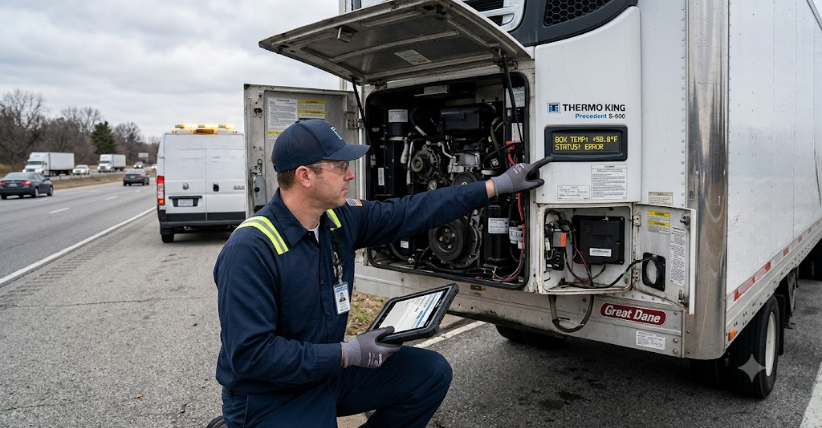
When you are pulling a loaded refrigerated trailer across Southern Ontario, few sights cause more anxiety than looking in your side mirror and noticing that your box temperature isn’t coming down. The reefer engine is humming loudly, the belts are turning, and the unit sounds like it is working hard—yet the temperature reading on the display screen refuses to drop.
Whether you are carrying fresh produce, frozen meat, ice cream, or temperature-sensitive pharmaceuticals, a cooling failure puts tens of thousands of dollars in cargo at immediate risk of load rejection.
At Road Safe, we answer emergency roadside calls every day from heavy truck drivers facing this exact mystery. Our mobile technicians provide fast 24/7 service Serving Brampton & all across the GTA. When a reefer unit is running but failing to cool the trailer, the problem usually comes down to refrigeration system leaks, component failures, airflow obstructions, or mechanical wear.
Here is a clear, simple guide explaining why your box temperature isn’t dropping and what you can do about it.
1. Is a Refrigerant Leak Causing Low Cooling Pressure?
Refrigerant gas (often referred to generically as Freon) is the lifeblood of your trailer’s cooling system. The reefer unit cools the trailer by circulating this gas under high and low pressure through a continuous closed loop, absorbing heat from inside the box and releasing it outside.
Why Leaks Happen on Ontario Highways
Commercial trailers endure constant vibration, severe potholes, and rough road surfaces while traveling along high-volume transit corridors like Highway 401, the QEW, Highway 410, and Highway 407. Over time, these heavy vibrations can cause:
Microscopic cracks in copper or aluminum refrigerant lines.
Loose fittings and rubber hose connection wear.
Pin-hole leaks in condenser or evaporator coils caused by winter road salt corrosion.
What Happens When Refrigerant Is Low?
If gas leaks out of the system, there isn’t enough pressure to complete the heat-transfer process. The reefer engine will continue to run at high speed, but the unit will only blow mild or room-temperature air into the trailer instead of freezing cold air.
What You Can Check:
Look at the small sight glass on the refrigeration unit (if equipped). If you see constant bubbles or foam instead of clear liquid, your refrigerant level is likely low.
Check for oily residue or dark grime buildup around hose fittings and coil corners, which often indicates leaking compressor oil carrying refrigerant gas out.
2. Has the Compressor Clutch or Internal Valve Failed?
The compressor is often called the “heart” of the reefer system. Its job is to pump refrigerant gas through the system, compressing it from a low-pressure gas into a high-pressure liquid.
The Clutch Mechanism
On many reefer units, an electric clutch engages the compressor when cooling is required. If the clutch slips, wears out, or suffers an electrical failure:
The reefer diesel engine will run smoothly, but the compressor shaft inside will not spin.
Without the compressor spinning, no refrigerant circulates, and zero cooling takes place.
Internal Valve Failure
Even if the compressor is spinning, internal components like valve plates or pistons can wear out over time. If an internal valve breaks or leaks pressure internally:
The compressor loses its ability to build high pressure.
The system pumps gas weakly without actually pulling heat out of the box.
What You Can Check:
Listen for a sharp “click” sound when the unit calls for cooling. If the diesel engine revs up but you don’t hear or see the compressor clutch engage, the clutch or its electrical solenoid may be dead.
If the engine runs continuously in high speed without bringing down the box temperature even a single degree over 20–30 minutes, an internal compressor valve failure is a strong suspect.
3. Are Blocked Expansion Valves (TXV) Stopping Refrigerant Flow?
The Thermal Expansion Valve (often called the TXV) acts as a precise metering gatekeeper inside the refrigeration circuit. It controls how much liquid refrigerant enters the evaporator coil inside the front of your trailer.
How a TXV Causes Cooling Problems
The TXV has a tiny opening inside that adjusts continuously based on temperature demand. If this valve becomes restricted or stuck shut:
Refrigerant cannot flow into the evaporator coil.
The system becomes “starved,” meaning no cold air is generated for the box.
What Causes Blockages?
Moisture in the lines: Small amounts of water vapor trapped inside the system can freeze into tiny ice crystals right at the TXV nozzle, completely blocking gas flow.
Debris & Contamination: Metal shavings from a wearing compressor or degraded filter-drier material can clog the small orifice.
What You Can Check:
If a TXV is frozen due to moisture, turning off the unit for 15–20 minutes may melt the internal ice pocket temporarily, allowing brief cooling before it freezes shut again. This is a clear sign that your filter-drier needs immediate replacement by a technician.
4. Is an Evaporator Coil Frozen Over in a Failed Defrost Cycle?
The evaporator coil is located inside the front bulkhead of your trailer. Fans draw air from inside the trailer, blow it across the freezing evaporator coil to drop its temperature, and push the cold air back along the ceiling to the rear of the trailer.
The Ice Buildup Problem
Because warm, humid air naturally holds moisture, frost constantly builds up on the evaporator coil during operation. Reefers are programmed to enter an automatic Defrost Cycle periodically, using hot gas or electric heaters to melt this ice away.
If the defrost system fails—due to a bad defrost sensor, faulty hot gas valve, or broken timer—the frost will build up into a solid block of ice covering the coil.
What Happens When the Coil Freezes?
Solid ice acts as a thick insulator, stopping heat transfer.
The ice physically blocks airflow, preventing the fans from circulating air through the trailer.
The reefer engine runs at high speed, but little to no air comes out of the top chute.
What You Can Check:
Walk to the back of the trailer (or check airflow at the front bulkhead) to feel if air is blowing strongly from the vents. Weak or non-existent airflow while fans are spinning usually points to a frozen evaporator coil.
You can manually trigger a defrost cycle from your Thermo King or Carrier display controller panel. If water begins pouring out of the trailer drain tubes underneath, the unit was heavily iced up.
5. Quick Summary: Driver Checklist for No-Cool Situations
When your reefer is running but failing to drop temperature, follow these simple steps:
| Observed Symptom | Likely Cause | Driver Action |
|---|---|---|
| Weak air blowing from chute | Evaporator coil frozen solid | Manually initiate a defrost cycle on the controller screen. |
| Strong airflow, but air is warm | Low refrigerant leak or failed compressor | Check sight glass for bubbles; check fittings for oil leaks. |
| Engine runs, no clutch click | Electrical clutch or solenoid failure | Inspect visible belts and electrical wiring connectors. |
| Unit cools briefly then stops | TXV valve blocked or moisture in line | Requires shop/mobile evacuation and filter-drier replacement. |
Fast Emergency Roadside Help When You Need It Most
If your reefer is running hard but your cargo temperature continues to creep into the danger zone, don’t wait for your load to spoil. Trying to force a malfunctioning unit to cool by resetting it repeatedly can cause severe compressor damage and costly repairs.
Road Safe provides fast, reliable 24/7 mobile roadside assistance and shop repairs. Our certified technicians travel directly to your location with specialized diagnostic gear, leak detectors, refrigerant recharge equipment, and replacement parts for both Thermo King and Carrier Transicold units.
We have mobile vans available Serving Brampton & all across the GTA. Whether you are stranded on the shoulder of the 401, parked at a truck stop in Brampton or Mississauga, or waiting at a loading dock in Toronto, we get your unit cooling cold and protect your valuable freight.
Need immediate reefer repair? Contact Road Safe today for rapid dispatch!
Frequently Asked Questions
1. Why is my reefer blowing warm air if the engine is running?
A running engine blowing warm air usually means you have a refrigerant leak, a worn compressor clutch, or an internal valve failure preventing cold gas from circulating.
2. What should I do if my reefer evaporator coil freezes over?
Run a manual defrost cycle from your controller screen. If ice melts and water drains out but it freezes again soon, your defrost sensor or heater system needs repair.
3. How do vibration and road conditions cause reefer cooling failures?
Heavy vibrations from potholes and rough highways can cause microscopic cracks in aluminum cooling lines, loosen hose fittings, or wear down compressor seals
4. What causes a reefer to cool for a few minutes and then stop?
Moisture trapped in the refrigeration lines can freeze into tiny ice crystals right at the expansion valve (TXV), blocking gas flow until the unit is turned off and thawed.
5. Does Road Safe offer emergency mobile reefer repair?
Yes, Road Safe provides 24/7 mobile roadside assistance and emergency reefer repairs serving Brampton and all across the GTA.
