
Driving a truck in the Greater Toronto Area (GTA) is tough enough. Between navigating the gridlock on the 401, dealing with erratic drivers on the DVP, and racing against tight delivery windows, you have a lot on your plate. But if you are hauling a refrigerated trailer—a reefer—the pressure doubles.
Hauling temperature-controlled freight means you aren’t just responsible for moving a box from Point A to Point B; you are responsible for keeping a highly sensitive environment perfectly chilled. In the food logistics and pharmaceutical worlds, a single mistake can ruin an entire shipment, leading to thousands of dollars in rejected loads, insurance headaches, and lost trust.
Here at Road Safe, we see owner-operators and fleet drivers face these challenges every day. The good news? Most reefer failures aren’t caused by catastrophic mechanical meltdowns. Instead, they happen because of simple, easy-to-miss mistakes during the daily hustle.
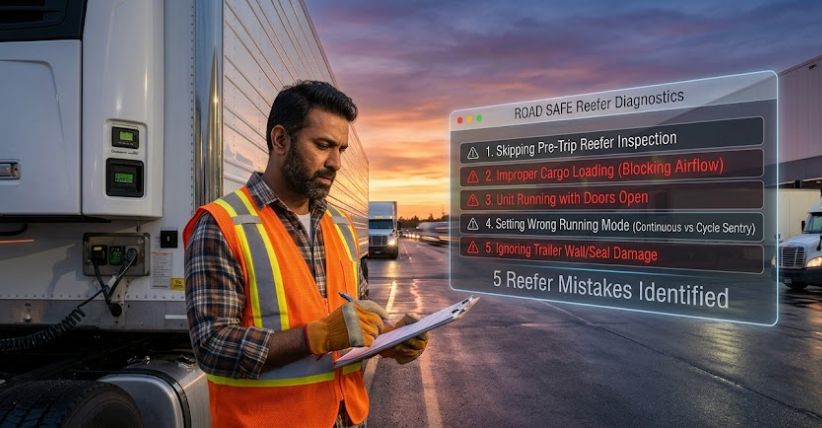
Here are the top five reefer mistakes GTA truck drivers make, and exactly how you can fix them to stay Road Safe and profitable.
1. Skipping the Pre-Trip Reefer Inspection
We get it. You are parked at a busy truck stop in Mississauga, your clock is ticking, and you want to get rolling before morning rush hour hits the city. It is incredibly tempting to just glance at the reefer’s control panel, see a green light, and hit the road.
Skipping a thorough pre-trip inspection on your reefer unit is playing Russian roulette with your cargo. A tiny issue at the yard can turn into a total cooling failure by the time you reach Vaughan.
How to Fix It:
Make the reefer unit a dedicated part of your pre-trip routine. Road Safe recommends spending just five extra minutes checking the basics before you turn the key:
Check the fluids: Just like your truck engine, your reefer relies on engine oil and coolant. Low levels will trigger an automatic engine shutdown on the highway.
Inspect the belts and hoses: Look for cracks, fraying, or green crusty leaks around hose connections.
Run a Pre-Trip Cycle: Modern units have a built-in automated pre-trip test. Initiate it while you check your trailer tires and lights. If a hidden error code exists, the system will catch it before you leave.
2. Inproper Cargo Loading (Blocking the Airflow)
You can have the most advanced, high-tech reefer unit on the market, but it won’t matter if the cold air can’t actually reach the back of the trailer. A very common mistake is packing the trailer too tightly or stacking pallets all the way to the very top and front wall.
Reefers work by circulating air. They blow cold air out of the top chute toward the back of the trailer, and draw warm air back in through the bottom front bulkhead. If you block either of these areas, you create “hot spots” where the temperature skyrockets, leading to cargo spoilage.
How to Fix It:
When loading up at a GTA distribution center, be active and supervise the process:
Keep the bulkhead clear: Ensure there is at least a few inches of clearance between the front wall wall (the bulkhead) and the first pallet so the return air intake isn’t suffocated.
Observe the ceiling boundary: Never stack boxes or pallets directly against the top air chute. Leave at least 10 to 12 inches of headspace for air to travel freely to the rear doors.
Check the floor: Ensure the T-channel floors are clean and free of debris (like shrink-wrap or broken pallet wood) that could block air moving under the load.
3. Leaving the Unit Running While Loading Doors Are Open
Picture this: It’s a humid July afternoon in Brampton. You back into a loading dock, pop your trailer doors open, and leave the reefer running while the warehouse crew takes an hour to load the product.
It sounds logical—you want to keep the trailer cold, right? Wrong. Leaving the unit running while the doors are wide open actually sucks hot, humid outside air right into the trailer. The moisture in that warm GTA air hits the freezing evaporator coils inside the reefer, causing them to flash-freeze into a solid block of ice. Once the coils ice up, the unit enters a prolonged defrost cycle, and it stops cooling the trailer entirely.
How to Fix It:
Always turn the reefer unit OFF before opening the trailer doors for loading or unloading.
Only turn the unit back on once the doors are completely closed and sealed.
If the warehouse requires the trailer to be pre-cooled, run the unit until it reaches the target temperature, shut it off, back into the dock, load quickly, close the doors, and fire it back up. This simple trick protects your equipment and saves an immense amount of diesel.
4. Setting the Wrong Running Mode (Continuous vs. Cycle Sentry)
Reefer units generally operate in two modes: Continuous Run (where the engine never stops) and Cycle Sentry / Start-Stop (where the engine turns off once the target temperature is reached and turns back on when it warms up).
Choosing the wrong mode is a classic blunder. Some drivers use Cycle Sentry for everything to save fuel. However, if you are hauling highly sensitive, fresh produce like berries or leafy greens, a slight temperature variance during the “off” cycle can ruin the crispness and get the load rejected at the grocery terminal. Conversely, using Continuous mode for deep-frozen goods when it isn’t necessary wastes money.
How to Fix It:
Always match your running mode strictly to the commodity notes on your Bill of Lading (BOL):
Continuous Mode: Use this for fresh, chilled, or highly perishable items (like meat, dairy, produce, and pharmaceuticals). These goods require constant airflow and steady temperatures to prevent spoilage.
Cycle Sentry / Auto-Start: Use this for deep-frozen products (like ice cream or frozen boxed goods) that have plenty of thermal mass and can easily handle slight temperature fluctuations without thawing.
When in doubt, check your company policy or consult your dispatcher to keep your cargo Road Safe.
5. Ignoring Trailer Wall and Door Seal Damage
GTA yards can be tight, and minor scrapes happen. However, ignoring a small gash in the trailer wall or a torn rubber gasket around the rear doors is a major mistake.
Refrigerated trailers rely heavily on polyurethane insulation built into the walls. If a forklift punctures the interior lining, or if a tight turn scrapes the exterior wall, moisture enters the insulation. Wet insulation loses its ability to keep the heat out. Similarly, a compromised door seal acts like a window left cracked open in winter—your reefer will work twice as hard, burn through fuel, and struggle to hold temperature.
How to Fix It:
Regularly inspect the physical body of your trailer:
Look for light leaking through the rear doors when you are inside the trailer—if you see daylight, warm air is getting in.
Check the interior walls for punctures from forklift blades. Seal minor punctures with heavy-duty reefer repair tape or silicone immediately to keep moisture out of the foam insulation.
Bring the trailer to a professional shop if you notice large bulges in the walls, which indicate the insulation has become waterlogged and needs replacement.
Drive Smart, Stay Road Safe
Hauling reefer freight in the Greater Toronto Area demands precision, but avoiding these five common mistakes will keep your operations smooth, your fuel costs down, and your customers happy. Taking those few extra minutes to check your airflow, manage your doors, and verify your settings makes all the difference.
Protect your equipment, protect your cargo, and keep your business moving forward. Stay smart out there, and stay Road Safe!
