
In the world of temperature-controlled logistics, a “Low Refrigeration Capacity” warning is the equivalent of a heart attack for your cargo. For owner-operators and fleet managers running through the Greater Toronto Area and Brampton, every degree of temperature rise is a step closer to a rejected load and a massive financial loss.
At Road Safe, we specialize in diagnosing these “invisible” killers. One of the most common, yet misunderstood, reasons for a loss in cooling power isn’t a lack of refrigerant—it’s a failure of the Thermostatic Expansion Valve (TXV).
The Deep Issue: What Exactly is "Low Capacity"?
When your Thermo King or Carrier unit throws a “Low Capacity” alarm, it means the system is running, but it isn’t absorbing heat efficiently. The unit is working hard, but the air coming out of the “chute” isn’t cold enough to drop the trailer temperature.
Many technicians make the mistake of simply “topping up the gas.” However, if your expansion valve is failing, adding more refrigerant is like trying to fix a clogged sink by turning the faucet on higher. It doesn’t solve the blockage; it just increases the pressure.
The Heart of the Problem: The Expansion Valve (TXV)
Think of the expansion valve as the “brain” of the refrigeration cycle. Its job is to precisely meter the amount of liquid refrigerant entering the evaporator coil.
1. How the TXV Works (And Why it Fails)
The TXV uses a sensing bulb to monitor the temperature of the refrigerant leaving the evaporator.
If it’s too hot: The valve opens to allow more cooling.
If it’s too cold: It closes to prevent liquid from hitting the compressor (which would destroy the engine).
The Failure Point: Over time, moisture or debris can get trapped inside the valve, or the internal diaphragm can lose its “charge.” This causes the valve to get stuck in a restricted position. When this happens, your evaporator is “starved” of refrigerant. You have plenty of freon in the tank, but it can’t get into the coils to actually cool your cargo.
2. The “Ice Block” Effect
A failing expansion valve often causes the evaporator to freeze over unevenly. Because the refrigerant isn’t flowing correctly, moisture from the air turns to ice on the coils, eventually blocking all airflow. At this point, your reefer is basically a giant, expensive fan blowing warm air over a block of ice.
Why Brampton Fleets Trust Road-Safe.ca for This Repair
Diagnosing a TXV issue requires more than just a set of gauges; it requires an understanding of Superheat.
Advanced Diagnostics: Our mobile technicians don’t just look at pressures. We measure the temperature at the evaporator outlet to calculate exactly how that valve is performing.
Moisture Removal: A TXV usually fails because of moisture in the system. When we replace a valve, we don’t just “swap parts.” We perform a deep vacuum to ensure 100% of the moisture is gone, preventing a repeat failure.
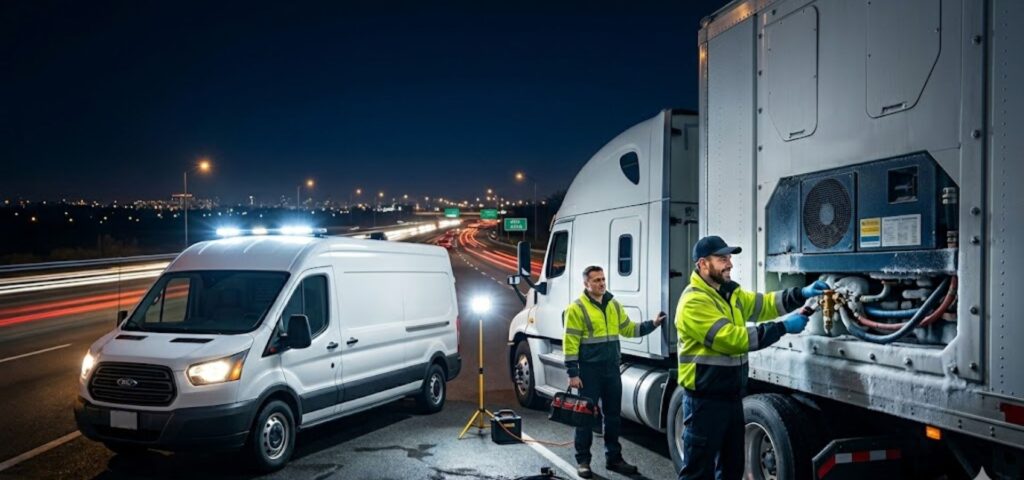
On-Site Recovery: We bring the repair shop to you. Whether you are at a truck stop in Brampton or a warehouse in Mississauga, we handle the refrigerant recovery and valve replacement on-site, saving you a trip to the dealership.
The Bottom Line: Don't Ignore the Alarm
A “Low Capacity” warning is a precursor to a total cooling failure. If you notice your unit is staying in “High Speed Cool” for hours without reaching the set point, your expansion valve is likely struggling.
Ignoring this doesn’t just risk the cargo; it puts extreme stress on your compressor, leading to a repair bill that could be five times more expensive than a simple valve replacement.
