
For a truck driver, every mile costs money. Every hour of downtime burns profit. Every missed delivery window damages trust.
Your truck is not just a machine. It is your office, your lifeline, and often your home. When you run through the Vaughan corridor—along Highway 400, Highway 7, or the 407—you are moving through one of Ontario’s busiest logistics hubs.
The pressure is constant. Shippers expect precision. Dispatchers demand punctuality. And the weather? It never cooperates.
In this environment, two systems determine your success: your reefer unit and your truck heater.
When they work, you hardly notice them. When they fail, your entire world stops.
This is the reality of reefer and heater repair in Vaughan. Let us talk about what keeps drivers up at night—and how Road Safe delivers the solutions you need.
Part One: The Reefer Nightmare
A Load Worth More Than Your Truck
Imagine this.
You just loaded $80,000 worth of temperature-sensitive pharmaceuticals in Vaughan. The reefer is set to precisely 4°C. The bill of lading clearly states: “Temperature excursion voids all warranty.”
You merge onto Highway 400 heading toward Montreal. The traffic is heavy. The sun is beating down on the trailer.
Twenty minutes into your trip, you glance at the reefer display. Your heart stops.
A blinking red error code stares back at you.
“How long has this been off?”
“Is the load already warming up above 5°C?”
“Do I pull over on the shoulder right now or risk pushing to the next exit?”
“Who pays for this if the entire shipment spoils?”
“Will my dispatcher even believe me, or will they think I am lying to cover a late delivery?”
These questions have no easy answers. But the clock is ticking. Every minute the reefer struggles, your load moves closer to complete rejection.
The Emotional Toll of a Reefer Breakdown
Let us be honest about something most blogs ignore.
A reefer breakdown is not just a mechanical problem. It is an emotional crisis.
You feel panic rising in your chest. Your palms sweat on the steering wheel. You start calculating numbers in your head—the value of the load, the cost of the tow, the days of lost income.
Then comes the shame. You wonder if you should have noticed the warning signs earlier. That strange noise last week. The temperature that took too long to stabilize. The error code that cleared itself and you chose to ignore.
Then comes the fear. Will your company put you out of service? Will your insurance premiums skyrocket? Will brokers stop offering you loads?
This is the hidden weight of reefer breakdowns. It is not just about repairs. It is about your livelihood, your reputation, and your peace of mind.
Why Vaughan Is a Hotspot for Reefer Failures
Vaughan is not a random location. It is a perfect storm for reefer problems.
First, the traffic. Highway 400, Highway 407, and Highway 7 see some of the heaviest truck traffic in Canada. Constant stop-and-go driving means your reefer cycles on and off repeatedly. Each cycle stresses the compressor. Each stress event brings failure closer.
Second, the warehouse density. Vaughan has hundreds of cold storage facilities. Trucks idle for hours waiting for dock doors. Idling reefer units accumulate run time without moving air. Condensers get clogged with warehouse dust. Fans wear out faster.
Third, the weather. Vaughan summers are hot and humid. Vaughan winters are brutally cold. Your reefer works overtime in both extremes. Heat kills compressors. Cold thickens refrigerant oil. Seasonal swings crack hoses and seals.
Small issues become big problems quickly. A dirty condenser coil that costs $200 to clean becomes a $4,000 compressor replacement. Low refrigerant that costs $300 to recharge becomes a $2,500 evaporator repair.
The Mechanical Reality: What Actually Breaks
Let us get technical for a moment. Understanding what fails helps you understand why specialized repair matters.
Compressors are the heart of your reefer. They fail due to oil starvation, electrical faults, or simply age. Compressor failure means the unit cannot build pressure. No pressure means no cooling. No cooling means load claim.
Evaporator fans circulate cold air inside the trailer. When a fan fails, cold air pools at the bottom while the top warms up. Your display shows the set temperature, but the load is already spoiling.
Condenser coils reject heat from the system. When coils are clogged with dirt, road salt, or warehouse debris, the reefer cannot shed heat. The compressor works harder and harder until it burns out.
Temperature sensors tell the controller what is happening inside the trailer. A faulty sensor can read -10°C when the actual temperature is +5°C. You think everything is fine while your load is dying.
Controller boards are the brains of the unit. They fail without warning. One bad capacitor, one corroded connection, and the entire unit goes dark.
Refrigerant leaks are the most common hidden problem. A small leak slowly reduces cooling capacity. You notice the reefer running longer than usual. You ignore it. Then one day, the system has no refrigerant left, and you have no cold air at all.
The Financial Reality: What a Breakdown Actually Costs
Let us do the math together.
A typical reefer breakdown in Vaughan involves:
- Towing to a shop: $500 to $1,000
- Diagnostic fee: $200 to $400
- Compressor replacement: $3,000 to $6,000
- Lost driving time: One to three days at $800 to $1,500 per day
- Load rejection penalty: $2,000 to $10,000 or more
- Future freight impact: Priceless
A single catastrophic reefer failure can cost you $10,000 to $20,000 or more. That is weeks of profit wiped out in a single day.
And that does not count the long-term damage. Brokers share data. When you develop a reputation for temperature excursions, premium loads stop coming your way. You end up hauling low-value freight with tight margins. The cycle continues.
The Solution: Specialized Reefer Repair in Vaughan
You need a shop that understands refrigerated transport at a cellular level.
You cannot afford to sit in a general mechanic’s parking lot while they fumble through a reefer manual. You need technicians who have seen every error code, every brand, every hidden failure mode.
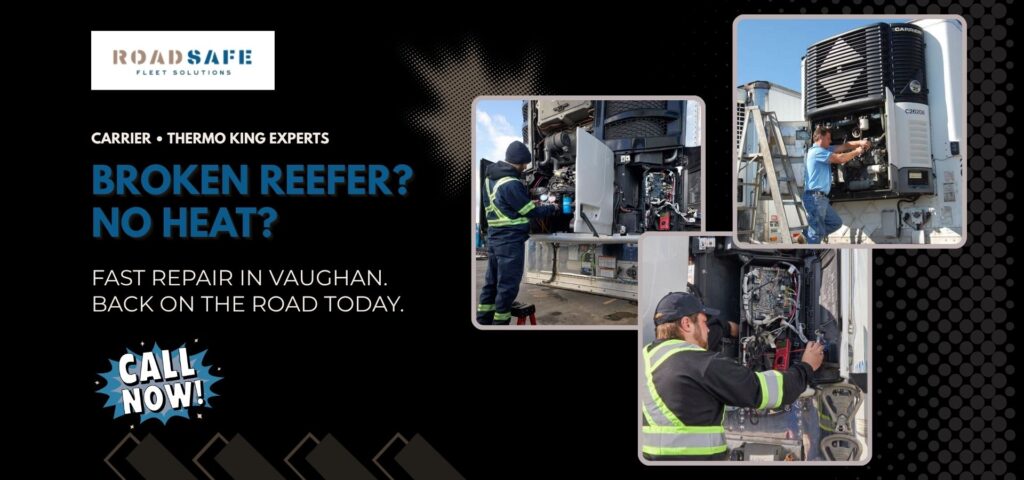
Road Safe offers specialized reefer repair in Vaughan . Their technicians are trained specifically on Carrier, Thermo King, and other major reefer brands. They carry common parts in stock. They have advanced diagnostic computers that speak your reefer’s language.
They understand that when a reefer goes down, every minute costs you money. They work efficiently to get your temperatures back where they belong. They do not guess. They diagnose, repair, and verify before you roll.
Do not trust your high-value freight to a general mechanic. Trust the specialists who protect your load, your reputation, and your livelihood.
Part Two: The Frozen Nightmare
The Cold That Gets Inside Your Bones
Now let us talk about winter. Not the romantic version. The real version.
It is 2:00 AM in January. You are parked at a truck stop near Highway 400 and Major Mackenzie in Vaughan. Your mandatory 10-hour break just started. You have driven 700 miles today. You are exhausted.
The temperature outside is -22°C. The wind chill makes it feel like -35°C. The wind is cutting through every seal, every gap, every poorly insulated panel in your truck.
You kick off your boots. You pull off your jacket. You climb into your bunk and pull the blankets up to your chin. You turn up the heat.
Nothing.
Cold air. Weak air. Maybe a whisper of lukewarm if you put your hand directly over the vent.
Your truck heater is dead. Or dying. Either way, you are freezing.
The Desperate Calculations of a Cold Night
Your exhausted mind starts running numbers.
- I cannot idle all night. Diesel is $1.60 per liter. Idling burns three liters per hour. That is nearly $80 just to stay warm until morning.
- But anti-idling fines in Vaughan can be $500 or more. Is it worth the risk?
- If I do not idle, how cold will it get in here? Can I survive in my sleeping bag?
- Hypothermia sets in when your core temperature drops below 35°C. How will I know if I am there?
- I have to drive in six hours. If I do not sleep tonight, I am dangerous behind the wheel. If I freeze all night, I am also dangerous.
This is not a hypothetical scenario. This happens to drivers every single winter in Vaughan. The 400 corridor does not care about your schedule. The cold does not care about your load.
The Safety Crisis No One Talks About
Here is the truth the industry does not discuss enough.
A failed heater is a safety crisis.
Sleeping in extreme cold fragments your rest. You wake up every hour. You never reach deep sleep. You start the next day already fatigued.
Fatigued driving is impaired driving. Your reaction time slows. Your decision-making deteriorates. Your risk of crash multiplies.
And then there is the defroster.
Your defroster depends entirely on your heater. No heat means no defrost. No defrost means you cannot see.
Imagine trying to merge onto the 401 at 6:00 AM with a windshield that is fogged solid on the inside and iced over on the outside. You cannot see the traffic coming at 100 km/h. You cannot see the lane lines. You cannot see the exit signs.
This is not discomfort. This is not an inconvenience. This is a life-threatening emergency.
Why Truck Heaters Fail in Vaughan Winters
Let us go deep on heater failures.
Coolant levels drop over time. A small leak in a hose, a weeping water pump, a tiny crack in the radiator. Low coolant means no heat. It is that simple. But finding the leak can take hours.
Thermostats stick open or closed. A thermostat stuck open sends coolant constantly through the radiator. The engine never warms up. The heater never gets hot coolant. A $20 part causes days of misery.
Blower motors fail slowly. First, the fan runs only on high speed. Then it makes grinding noises. Then it stops altogether. No fan means no air movement. No air movement means no heat reaches you.
Blower motor resistors control the fan speed. When the resistor fails, the fan might work on high but not on low. Or it might not work at all. Another small part with big consequences.
Heater cores are the worst. They are buried deep inside the dashboard. Replacing one requires removing half the interior. The part costs $200. The labor costs $2,000. But a clogged or leaking heater core leaves you with no heat at all.
Air in the cooling system happens after repairs. Air pockets prevent coolant from circulating through the heater core. The engine runs at normal temperature. The heater blows cold. And you have no idea why.
The Diagnosis Challenge
Here is why heater problems frustrate even experienced mechanics.
The symptoms are vague. “No heat” could be ten different problems. A general mechanic starts guessing. They replace the thermostat. No change. They replace the blower motor. No change. They flush the cooling system. No change.
You pay for all these guesses. Your truck sits for days. You lose income. And you still have no heat.
Specialized diagnostic approach matters. A technician who understands heavy-duty HVAC starts with the basics. Check coolant level. Check for leaks. Check thermostat operation. Check blower motor function. Check heater core temperature differential. Work systematically. Find the actual problem. Fix it once.
The Cost of a Cold Night
Let us calculate what a heater failure costs you.
One night of idling to stay warm: $80 in fuel plus risk of $500 fine
One night of no sleep due to cold: Fatigue that impairs your next driving shift
One missed delivery because you could not defrost your windshield: $500 to $2,000 in late fees
One trip to a general mechanic who guesses wrong: $500 to $1,000 with no solution
One proper repair at a specialized shop: $500 to $2,000 depending on the issue
But the real cost is the human cost. A driver who is exhausted, cold, and stressed is not safe. Not for themselves. Not for the motoring public. Not for the freight they carry.
The Solution: Professional Truck Heater Repair
Do not wait until you are shivering to address heater problems.
Watch for the warning signs. Heat that takes longer than usual to warm up. Air that feels lukewarm instead of hot. A blower motor that sounds different. Coolant smell inside the truck. Fog that does not clear from the windshield.
When you notice any of these, act immediately.
Pull into Road Safe before the problem becomes an emergency. Their team diagnoses heating system issues quickly and accurately. Whether it is a simple coolant top-up, a thermostat replacement, a blower motor repair, or a full heater core job, they have the expertise to get you warm again.
A warm truck means quality rest. Quality rest means safe driving. Safe driving means you go home at the end of your shift.
The Vaughan Advantage: Why Location Matters
Vaughan sits at the heart of Ontario’s logistics network. Highway 400, Highway 407, and Highway 7 all converge here. Thousands of trucks pass through Vaughan every single day.
When something breaks, you have a choice. Push forward with a failing system and hope for the best. Or find a shop you can trust.
The wrong choice costs time, money, and safety.
Avoiding the Quick Fix Trap
We see this story every week.
A driver is under deadline. They stop at the nearest general shop. The mechanic says confidently, “Yeah, I can fix that.”
Two hours and $800 later, you are back on the road.
Fifty miles down the highway, the same error code appears. The same cold air blows from the vents.
Now you are worse off than before. Less time on your clock. Less money in your pocket. No solution in sight. And now you are farther from a specialized shop than you were when you started.
Do not fall for the quick fix trap.
Why Specialization Wins Every Time
You would not take your reefer to an oil change shop. You should not take your truck’s heating system to a general mechanic either.
Specialized heavy-duty repair matters for three reasons.
First, experience. A specialized technician has seen your exact problem before. They know the common failure modes for your brand, your model, your year. They do not waste time guessing.
Second, tools. Specialized shops have diagnostic computers that speak your truck’s language. They can read fault codes that generic scanners cannot access. They have specialized tools for heater core replacement, refrigerant recovery, and electrical diagnosis.
Third, efficiency. Time is money. Specialized shops work faster because they know exactly what to look for. They have common parts in stock. They get you back on the road hours or days sooner than a general shop could.
When you choose Road Safe for reefer and heater repair in Vaughan , you choose a team that handles these systems daily. They understand the urgency. They know that downtime is your enemy. They work fast, right the first time, and get you rolling.
Don't Let Downtime Define Your Week
Your truck is your business.
When the reefer fails, your freight is at risk. Your reputation is at risk. Your income is at risk.
When the heater fails, your safety is at risk. Your rest is at risk. Your ability to drive is at risk.
Both systems are essential. Both deserve specialized attention. Both can be the difference between a profitable week and a disastrous one.
Before your next load takes you through Vaughan, know where to go. Stop gambling with roadside guesswork. Stop freezing through sleepless nights. Stop watching error codes flash while your load spoils.
Trust the professionals who keep Vaughan’s trucks moving safely and profitably.
Consultation
For drivers operating across Vaughan, Milton, Oakville, and surrounding GTA routes, Road Safe provides specialized diagnostics, repair, and preventive maintenance for heavy-duty refrigeration and heating systems.
Their technicians are trained on major reefer platforms and heavy-duty HVAC systems, ensuring accurate fault detection and efficient repair — without unnecessary part replacements or trial-and-error diagnostics.
