
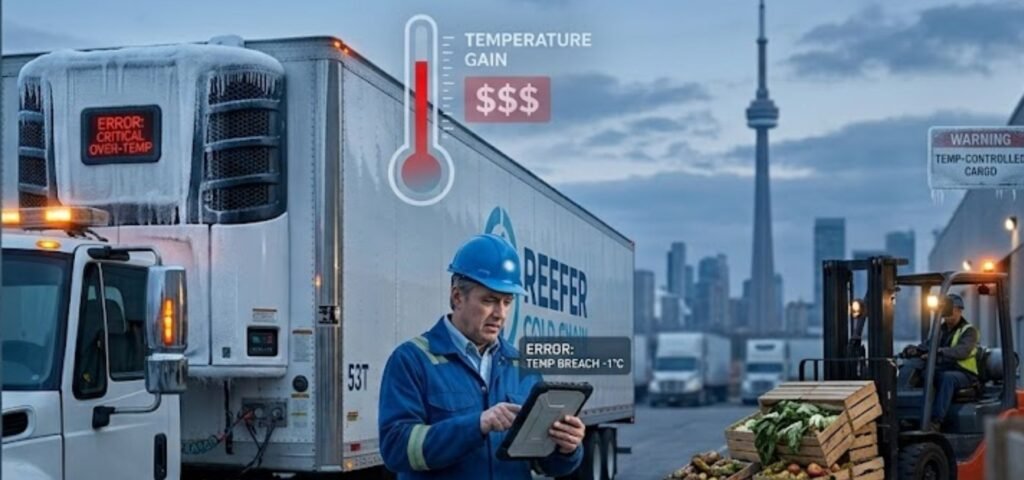
The Greater Toronto Area (GTA) serves as Canada’s primary supply chain engine, moving billions of dollars worth of perishable goods through dense transportation corridors every year. From fresh produce coming through the Ontario Food Terminal to high-value pharmaceuticals bound for Mississauga’s logistics hubs, temperature-controlled transport—known as reefer freight—is the quiet backbone of the regional economy.
Yet, for fleet operators, owner-operators, and supply chain managers working across the 401, QEW, and 407, a minor reefer issue often gets brushed aside during busy shifts. A subtle 2°C temperature creep, a slight refrigerant noise, or a minor sensor discrepancy might seem manageable in the moment.
Ignoring these warning signs in a fast-paced environment like the GTA leads to staggering financial and operational costs. At Road Safe, we specialize in helping carriers protect their fleets, their cargo, and their bottom lines from these costly oversights.
The Domino Effect of Cargo Loss
The immediate consequence of an unaddressed reefer issue is direct product loss. Modern reefer units do not simply keep things cold; they maintain precise climate control profiles tailored to specific cargo, ranging from deep-frozen meats (-18°C) to sensitive biological materials (2°C to 8°C).
When a reefer system experiences mechanical failure—such as a faulty compressor, low refrigerant levels, or a blocked airflow system—the temperature in the trailer quickly drifts out of specification. In cargo shipping, a total temperature breach almost always results in a total loss.
Consider the cost profile across typical sectors operating in the GTA:
Fresh Produce & Dairy: A single 53-foot trailer loaded with high-grade produce or specialty cheeses easily holds $50,000 to $100,000 in inventory.
Pharmaceuticals & Medical Supplies: Cold-chain pharma loads passing through GTA distribution centers routinely exceed $500,000 to $1,000,000 in value. A brief thermal spike renders the entire shipment legally unusable due to Health Canada regulatory standards.
When a receiver rejects a spoiled load at a GTA distribution dock, the carrier isn’t just losing out on freight charges—they are facing massive cargo claims, disposal fees, and clean-up expenses that Road Safe helps fleets prevent through rapid emergency support and continuous maintenance.
GTA Gridlock Amplifies Thermal Failures
A reefer malfunction that might be manageable in rural Ontario becomes a total disaster in the GTA due to severe traffic congestion.
On highways like the 401, 410, or 403, a truck can easily spend two hours moving just 20 kilometers during peak rush hour. When a reefer unit drops into fail-safe mode or suffers continuous cycling issues while idling in gridlock, the lack of ambient airflow around the trailer further accelerates thermal breakdown.
What could have been fixed with a quick pull-over at a service shop turns into hours trapped in traffic with a dying cooling unit. The GTA’s infrastructure offers little margin for error when temperature control begins to fail, making Road Safe’s mobile repair response essential for trapped drivers.
Hidden Costs Beyond the Immediate Loss
Focusing only on the ruined cargo misses the substantial hidden expenses that pile up after a reefer failure.
| Cost Area | Hidden Impact |
|---|---|
| Insurance Premiums | Submitting a single refrigerated cargo claim spikes commercial insurance premiums for years. Repeat claims lead to higher deductibles or policy non-renewal. |
| Emergency Repair Surcharges | A planned, preventive maintenance check with Road Safe costs a fraction of an emergency roadside service call during off-hours or weekend shifts. |
| Reputational Damage | Shippers in the GTA operate on tight delivery windows. Failing to deliver pristine cargo damages client relationships, leading to canceled contracts and blacklisting by major brokers. |
| Regulatory Fines | Transporting contaminated or unsafe food products risks severe penalties under Safe Food for Canadians Regulations (SFCR). |
Common Red Flags Fleet Managers Overlook
Reefer systems rarely fail completely without warning. Most catastrophic breakdowns stem from minor issues that were logged but ignored:
Short-Cycling: The unit repeatedly turns on and off over short intervals, straining the engine and electrical relays.
Sensor Anomalies: Displaying minor discrepancies between supply-air and return-air temperatures, often signaling calibration failure or faulty probes.
Frost & Ice Accumulation: Evaporator coils icing over, which chokes airflow through the trailer even if the refrigeration unit is running at max capacity.
Unusual Vibration or Fluid Leaks: Small oil or coolant drips underneath the unit frame indicating early-stage seal or compressor failure.
Proactive Protection with Road Safe
Mitigating reefer risks in the GTA requires shifting from a reactive mindset to a continuous prevention model. Road Safe recommends taking four proactive steps:
Conduct Pre-Trip Inspections (PTI): Always run a full electronic PTI before pulling up to a loading dock. Verify seal integrity, clear defrost drains, and test setpoint accuracy.
Implement Telematics & Real-Time Monitoring: Modern reefer units should be integrated with IoT telematics that send immediate alerts to dispatchers if trailer temperatures deviate even 1°C from setpoint.
Partner with Road Safe for Local Maintenance: Leverage Road Safe’s dedicated team across key GTA hubs (Brampton, Mississauga, Vaughan, Scarborough) to ensure rapid 24/7 response when minor glitches occur.
Enforce Airflow Standards: Ensure drivers load pallets with sufficient air chutes and wall clearance. Poor airflow can simulate a reefer failure even when the mechanical unit is working perfectly.
Protecting the Bottom Line
In the high-density freight landscape of the Greater Toronto Area, ignoring a reefer issue is a high-risk gamble. The financial exposure extends far past a minor repair bill—it encompasses total cargo loss, operational delays in heavy traffic, soaring insurance rates, and permanent damage to commercial reputation.
By prioritizing routine maintenance, monitoring data in real time, and partnering with Road Safe to react instantly to minor system warnings, GTA fleets can protect their bottom line and keep Ontario’s vital cold chain moving without interruption.
Frequently Asked Questions
1. What happens if a reefer unit fails while stuck in GTA traffic?
Heavy congestion on routes like the 401 or QEW restricts airflow around the trailer and increases idling times. This accelerates thermal breakdown, turning a minor temperature drift into a total cargo loss before the driver can reach a service shop.
2. How much financial loss can a single spoiled load cause?
Depending on the freight, a rejected load can range from $50,000 for standard produce or dairy up to $1,000,000 or more for high-value pharmaceuticals that must follow strict Health Canada temperature standards.
3. What are the hidden costs of ignoring minor reefer issues?
Beyond replacing ruined cargo, fleet owners face spiking commercial insurance premiums, high emergency roadside repair surcharges, regulatory penalties under Safe Food for Canadians Regulations (SFCR), and permanent loss of client trust.
4. What are the early warning signs of a failing reefer system?
Key red flags include short-cycling (turning on and off frequently), sensor temperature discrepancies, frost or ice accumulation on evaporator coils, and unusual vibrations or fluid leaks beneath the unit frame.
5. How can fleets in the GTA prevent sudden reefer failures?
Carriers can avoid catastrophic failures by conducting thorough Pre-Trip Inspections (PTI), installing real-time telematics for immediate temperature alerts, maintaining proper pallet airflow, and partnering with local emergency repair services like Road Safe.
