
In the commercial transport sector across the Greater Toronto Area (GTA), managing temperature-controlled logistics is a balancing act between protecting cargo and controlling operating costs. When a refrigeration unit goes down, it is rarely a sudden stroke of bad luck. Most of the time, it is the predictable result of stretched service intervals.
To help fleet managers and owner-operators protect their bottom line, we break down the critical business metrics and operational realities of refrigeration upkeep. Understanding these concepts will save your business thousands of dollars in emergency breakdown fees and protect your Total Cost of Ownership (TCO).
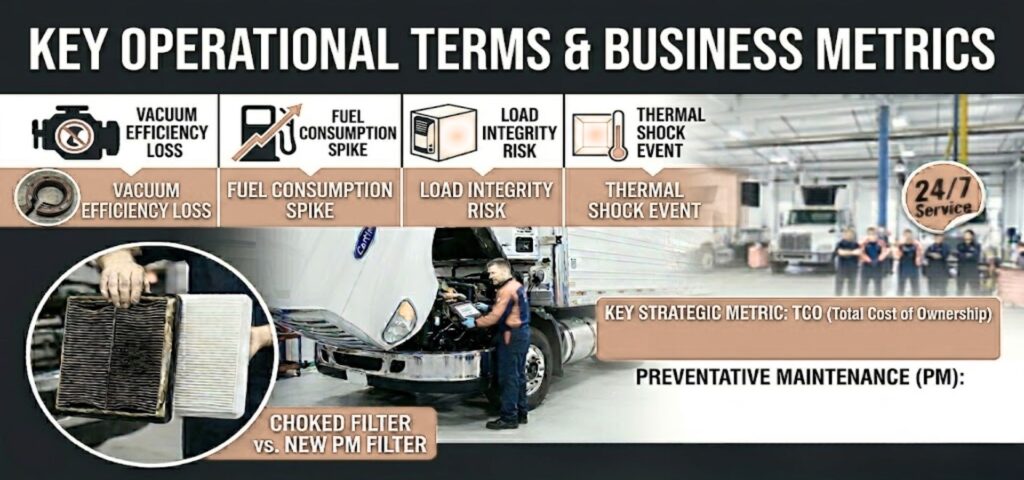
1. Vacuum Efficiency Loss (Blown Engine Seals)
When a reefer unit goes too long without a basic air filter change, the filter becomes completely choked with highway debris. Because the engine pistons continue to move, desperately trying to pull air into the combustion chamber, it creates a powerful internal vacuum pressure.
This restriction results in a massive Vacuum Efficiency Loss. The pressure builds up until it destroys the engine’s weakest points—the seals. In our shop, we regularly see Carrier units with blown front crankshaft seals, causing severe oil leaks that leave engine oil covering the entire unit.
2. Fuel Consumption Spike (Terrible Fuel Economy)
A choked engine is an inefficient engine. When the critical air-to-fuel ratio is thrown off balance by a blocked intake filter, combustion performance drops immediately.
To maintain the required operating speed and keep up with demand, the mechanical governor is forced to pump extra diesel into the cylinders. This creates a severe Fuel Consumption Spike. In a competitive market where diesel prices directly control your margins, burning extra fuel just to combat a dirty $100 filter is massive financial waste.
3. Load Integrity Risk & Thermal Shock Events (Poor Cooling)
When your diesel engine is starved for air and losing oil, it cannot drive the refrigeration compressor at peak performance. This leads to two major issues:
Load Integrity Risk: The unit struggles with slow pulldown times, jeopardizing high-value produce, meat, or pharmaceutical cargo.
Thermal Shock Event: Extreme temperature fluctuations inside the trailer can ruin cargo quality, leading to rejected loads at the receiver’s dock.
The Strategic Metric: Total Cost of Ownership (TCO)
Every smart fleet manager tracks TCO (Total Cost of Ownership)—the combined cost of acquiring, operating, and maintaining an asset.
When you skip a standard service to save a quick buck, your TCO spikes. A cheap service or a skipped filter replacement consistently results in an unanticipated emergency cost that is 10x the price of standard Preventative Maintenance (PM).
Clear Point-to-Point Summary:
Choked Filter vs. New Filter: A simple air filter replacement prevents catastrophic internal engine pressure.
The Golden Rule: Schedule regular PM service every 6–8 months to protect your engine longevity and maintain peak fuel efficiency.
Expert Reefer Repair in the GTA
Don’t wait for a blown seal, a severe oil leak, or a rejected load to disrupt your operations. Keep your commercial trucks compliant, efficient, and profitable on the road.
At Road Safe, we specialize in professional, high-tier reefer repair in GTA. Our team provides reliable preventative maintenance, precise diagnostics, and 24/7 roadside emergency service to keep your cold chain entirely secure.
