
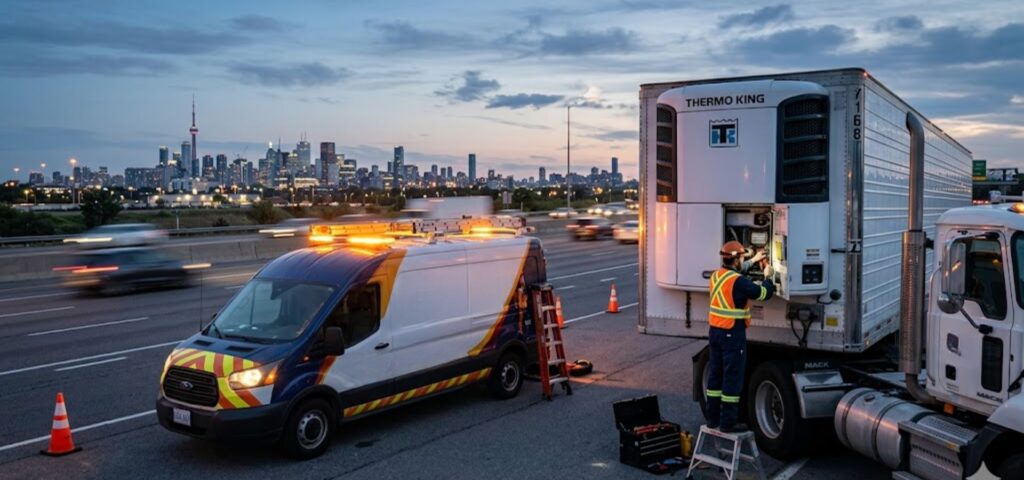
For a truck driver, the “hum” of a refrigerated unit is the most beautiful sound in the world. It’s the sound of a job going well, a cargo staying fresh, and a paycheck being secured. But the moment that hum turns into a sputter, or worse—silence—the stress levels hit the red zone.
Driving a reefer in the Greater Toronto Area (GTA) is uniquely challenging. Between the grueling traffic on the 401, the strict delivery windows at grocery distribution centers in Brampton, and the unpredictable Ontario weather, a driver has enough to worry about without their equipment failing.
At Road Safe Fleet Solutions, we’ve spent years on the shoulders of GTA highways helping drivers out of tight spots. We know that when a reefer goes down, you aren’t just looking for a mechanic; you’re looking for a lifeline. This guide is written specifically for the drivers—to help you identify issues early, manage a breakdown, and get back on the road before your load spoils.
1. The Nightmare Scenario: When the "Green Light" Turns Red
Every reefer driver knows the “mirror check.” You glance at the corner of your trailer to see that reassuring green light. But what happens when you see a flashing amber light or, even worse, total darkness?
A reefer failure isn’t just a mechanical issue; it’s a financial emergency. In the GTA, where you might be stuck in traffic for two hours trying to reach a receiver, a unit that isn’t maintaining temperature can lead to a rejected load. A rejected load means insurance claims, lost time, and a stain on your professional record.
2. Top 5 Reefer Issues Every Driver Faces
Through our 24/7 emergency service calls at (905) 299-9080, we see the same patterns emerging. Here are the most common “driver-side” reefer headaches:
A. The "Fail to Start" (Dead Batteries & Starters)
This is the #1 call we get during a GTA cold snap. You park for your 10-hour reset, the unit is set to “Start/Stop” mode, and during the night, the battery dies.
- The Driver’s Struggle: You wake up to a “Battery Low” or “Check Starter” alarm.
- The Cause: Cold weather saps battery voltage, and reefer engines require a high “cranking” power that a weak battery just can’t provide.
B. The Out-of-Range Alarm
You’re cruising through Mississauga when the alarm buzzer goes off. The set point is -20°C, but the return air is reading -5°C.
- The Driver’s Struggle: You check the fuel—it’s full. You check the doors—they’re locked. Why is the temperature climbing?
- The Cause: Usually, this is a refrigerant leak or a broken belt. In the GTA, road vibrations can rattle fittings loose, leading to a slow “freon” leak that eventually kills the cooling capacity.
C. Airflow Blockages (The Hidden Enemy)
Sometimes the unit is working perfectly, but the cargo is still getting warm.
The Driver’s Struggle: The unit says it’s at temperature, but when you open the doors at the receiver, the back of the load is soft or melting.
The Cause: This is often due to a fallen air chute or improper loading. If the air can’t circulate to the back of the trailer, you get “hot spots.”
D. Frozen Evaporator Coils
If you are hauling high-moisture loads (like fresh produce) during a humid Ontario summer, your coils can ice up.
The Driver’s Struggle: The unit is running high-speed, but the temperature won’t drop.
The Cause: Too much moisture in the trailer causes ice to build up on the coils, blocking airflow. You need a manual defrost, but sometimes the “Defrost” cycle itself fails.
E. Fuel System Priming Issues
Running out of reefer fuel is a rookie mistake, but it happens to the best of us. However, simply adding diesel isn’t always enough.
The Driver’s Struggle: You added fuel, but the unit still won’t start.
The Cause: Air has entered the fuel lines. Modern Tier 4 engines are notoriously difficult to prime by hand on the side of a busy highway.
3. The "Road Safe" Strategy: What to Do When You Break Down
If you are sidelined in Brampton, Vaughan, or anywhere in the GTA, follow these steps to maximize your chances of saving the load:
Don’t Panic, Check the Code: Most Thermo King and Carrier units provide a numerical error code. Write it down. This tells us exactly which sensor or component is failing.
Verify the Cargo: If you have a handheld pulp thermometer, check the temperature of the product (if accessible). This gives you an idea of how much “buffer time” you have.
Keep the Doors Closed: It sounds obvious, but every time you open those doors to “check” the cargo, you lose precious cold air.
Call Road Safe Fleet Solutions Immediately: Don’t wait three hours hoping the unit will “fix itself.” Our mobile repair units are stationed across the GTA. With our under 30-minute arrival time, we can often fix the issue before the cargo temperature moves even one degree.
4. Why GTA Drivers Trust Road Safe Fleet Solutions
We aren’t just another repair shop. We are a specialized team that understands the “driver’s life.”
We Speak Your Language: We know the difference between a “Check Alarm” and a “Shutdown Alarm.” We won’t waste your time with jargon; we get to work.
24/7/365 Availability: Refrigerated cargo doesn’t care if it’s Christmas Day or 2:00 AM on a Sunday. Neither do we.
Mobile Diagnostics: Our vans are equipped with the same high-level diagnostic computers found in major dealerships. We can clear codes, force regens, and test sensors right there on the shoulder of the 401.
Transparent Pricing: We know drivers and owner-operators work hard for their money. We offer fair, upfront rates with no “hidden emergency fees” that some other shops tack on.
5. Pro-Active Tips for Drivers (The "Pre-Trip" Checklist)
To avoid seeing us on the side of the road (as much as we love seeing you!), incorporate these into your daily routine:
The 15-Minute Pre-Trip: Don’t just check the fuel. Start the reefer 15 minutes early and run a “Pre-trip” test (most units have an automated self-test button).
Visual Belt Check: Look for “fraying” or cracks on the alternator and compressor belts. If they look shiny or glazed, they are slipping.
Clean the Floor: Debris on the trailer floor can clog the return air intake. A clean trailer is a cool trailer.
Check the Chutes: Ensure your air chutes aren’t sagging or disconnected.
6. Serving the Heart of the GTA Logistics Hub
Whether you are picking up a load in Mississauga, dropping off in Markham, or passing through Milton, Road Safe Fleet Solutions is your local partner. We cover:
Brampton: The hub of the GTA’s trucking industry.
Vaughan: Supporting the massive distribution centers along the 400.
Etobicoke & Toronto: Navigating the tight city streets to reach you where the big shops won’t go.
Conclusion: Don't Let a Breakdown Freeze Your Business
In the trucking industry, your reputation is built on reliability. When you’re hauling reefer loads, that reliability depends on a machine that is constantly vibrating, burning fuel, and fighting the elements.
When that machine fails, you need a partner who moves as fast as you do. Road Safe Fleet Solutions is dedicated to keeping GTA drivers moving. We understand that your trailer isn’t just a box—it’s a commitment you’ve made to your customer.
Next time you see a red light on your reefer, or the engine won’t turn over, don’t sweat it.
