
In the high-stakes world of temperature-controlled logistics, your reputation is only as good as the temperature log on your last delivery. For owner-operators and fleet managers across the Greater Toronto Area, the reefer unit is the heart of the business. When that heart starts to fail—indicated by a “Low Capacity” warning or a slow rise in box temperature—the pressure is on to get back on the road.
This pressure has given birth to a dangerous and expensive trend in the industry: The Recharge Culture. At Road Safe, we recently encountered a unit that serves as a perfect cautionary tale. This Thermo King unit had been “fixed” and topped off with refrigerant multiple times by various shops. Each time, the driver was told the unit was good to go. Each time, the unit failed mid-haul, leading to thousands of dollars in lost time and stressed cargo.
The problem? A micro-leak that everyone else was too rushed to find.
1. The Refrigerant Fallacy: "It Just Needs a Top-Off"
One of the most persistent myths in heavy-duty transport is that refrigeration units naturally “consume” refrigerant over time. Let’s set the record straight: A refrigeration system is a closed loop. Unlike fuel or DEF, refrigerant does not burn off. If the levels are low, there is a hole. It might be as large as a cracked discharge line or as small as a pinhole in the evaporator coil, but it is there. When a technician suggests a “top-off” without a pressure test or a leak search, they aren’t fixing your truck; they are selling you a subscription to future failure.
2. Anatomy of a Micro-Leak: Why They Are Missed
In the video captured at our Brampton facility, the culprit was a classic micro-leak. These are the “silent killers” of the cold chain. They are often missed for three specific reasons:
A. Vibration and Friction
Reefer units endure constant vibration from the road and the diesel engine itself. Over time, a copper line vibrating against a steel bracket or a plastic clip will wear down. This creates a microscopic opening. Because the leak only occurs significantly under certain pressures or vibrations, a static technician might miss it.
B. Thermal Expansion
Metal expands when hot and contracts when cold. A leak might only “open up” when the unit is working at maximum capacity on a hot Ontario afternoon. If a shop tests the unit while it’s cool and idle, the system might appear sealed.
C. Surface Contamination
Road salt from GTA winters, grease, and dust can coat the lines, effectively “plugging” a micro-leak temporarily during a visual inspection. It takes a dedicated professional using specialized equipment to see past the grime.
3. The Real Cost of "Cheap" Repairs
On paper, a $200 refrigerant recharge looks better than a $1,000 diagnostic and repair bill. However, the math changes quickly when you look at the “hidden” costs of avoidant maintenance:
The Rejected Load: If your unit fails with a load of fresh produce or pharmaceuticals, you aren’t just out the repair cost; you’re out the value of the cargo. Insurance premiums rise, and your relationship with the broker is damaged.
Compressor Burnout: Refrigerant carries the oil that lubricates the compressor. When the gas leaks out, the oil stops circulating. Running a unit low on refrigerant is the fastest way to seize a compressor, turning a simple patch job into a $5,000+ overhaul.
Fuel Inefficiency: A unit with a micro-leak has to run longer and harder to maintain the set point. You’ll see your reefer fuel consumption skyrocket as the engine struggles to compensate for the loss of cooling capacity.
4. The Road Safe Difference: Our Diagnostic Process
At Road Safe, we serve the Brampton and Mississauga trucking communities with a “Fix It Once” philosophy. When a unit enters our shop, we don’t just reach for the gauges; we reach for the diagnostic tools.
Electronic Sniffing: We use high-end sensors capable of detecting refrigerant parts-per-million in the air.
Nitrogen Pressure Testing: By draining the system and filling it with high-pressure nitrogen, we can hear and see leaks that would stay hidden under normal operating pressures.
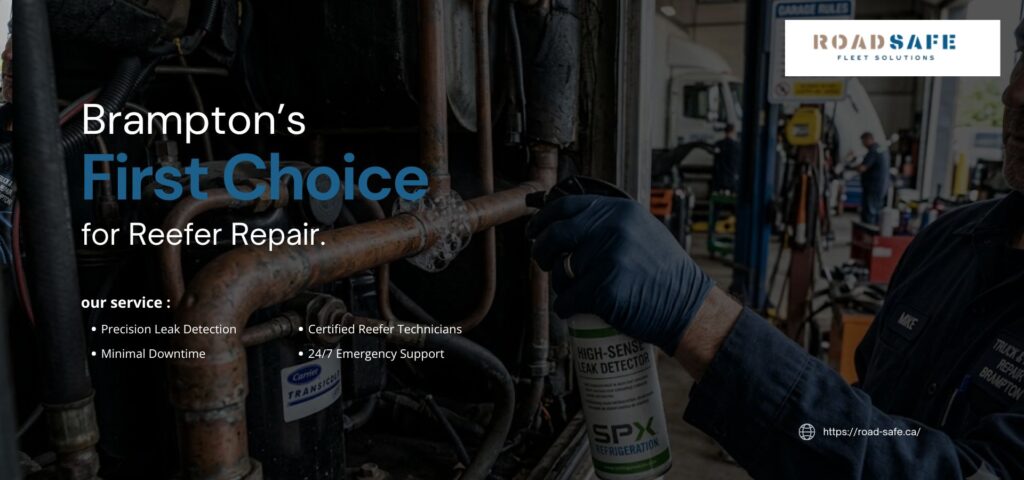
The Bubble Test: As demonstrated in our media, once we narrow down the zone, we use high-viscosity leak detectors to find the physical bubbles. If there’s a bubble, there’s a problem.
5. Proactive Maintenance for GTA Fleet Owners
The 401 and the terminal hubs in Brampton are some of the busiest in North America. The stop-and-go traffic and extreme Canadian temperature swings are brutal on reefer units.
To stay ahead of the “Low Capacity” alarm, we recommend:
Quarterly Pressure Checks: Don’t wait for an alarm.
Vibration Dampening: Inspecting brackets and clips to ensure lines aren’t rubbing.
Coil Cleaning: Removing the road salt and debris that lead to corrosion and “pinholing” in the coils.
6. Conclusion: Stop the Band-Aids
If you are an owner-operator in Brampton, your truck is your office and your reefer is your bank account. Don’t let a “quick fix” technician drain your savings. The next time you’re told you just need a “top-off,” ask for a leak test. Or better yet, bring it to the specialists who know how to find the bubbles.
Road Safe is committed to keeping the GTA’s cold chain moving. We don’t just add gas; we add reliability.
