
In the trucking industry, we have a saying: “If you think a professional is expensive, wait until you hire an amateur.”
For owner-operators and fleet managers in Brampton and across the GTA, every dollar counts. With rising fuel costs, insurance premiums, and maintenance overheads, it is tempting to look for the cheapest possible fix when a warning light pops up on your reefer unit. You might think, “It’s just a sensor,” or “Any mechanic with a torch can fix a leak.”
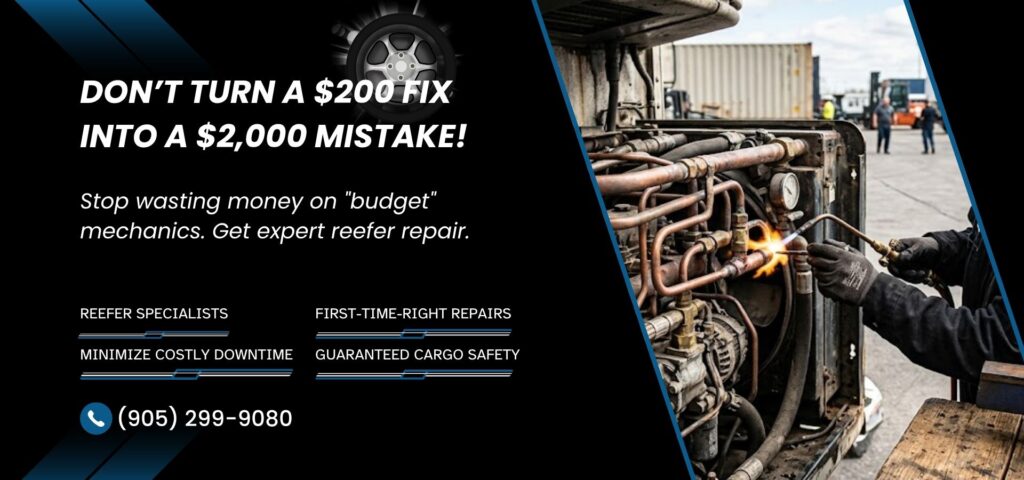
But as we recently saw at Road Safe, a “budget” repair that should have cost $200 quickly spiraled into a $2,000 disaster.
In this guide, we’ll break down why specialized reefer repair is the only way to protect your cargo, your equipment, and your bank account.
1. The Anatomy of a $2,000 Mistake
Reefer units—whether you’re running a Thermo King or a Carrier Transicold—are not just “fridges on wheels.” They are highly complex pieces of engineering that combine a diesel engine, a high-pressure refrigeration system, and sensitive electronic controllers.
We recently had a client come into our Brampton shop after a general truck mechanic tried to fix a simple gauge sensor issue. Instead of using the correct tools and specialized knowledge, the mechanic “butchered” the plumbing and the brazing joints.
What went wrong?
Improper Brazing: General mechanics often use standard welding or soldering techniques that aren’t meant for the high-vibration environment of a reefer. This leads to hairline cracks and refrigerant leaks.
Contamination: If the system is opened without proper vacuuming and sealing, moisture enters the lines. Moisture is the number one killer of reefer compressors.
Incorrect Diagnostics: A generalist often “guesses” by replacing parts that aren’t broken, hoping to stumble onto the fix.
By the time the unit reached us, we didn’t just have to fix a sensor; we had to rebuild the damaged plumbing, flush the contaminated system, and replace expensive components that were ruined by the first “fix.”
2. General Mechanic vs. Reefer Specialist: What’s the Difference?
Many shops claim they can “do it all.” While a general mechanic is great for your truck’s brakes, tires, or oil changes, the reefer unit requires a different skillset.
The Specialist's Edge:
Specific Training: A reefer technician understands the logic of the microprocessor. They know how the unit thinks and can pinpoint an electrical fault in minutes that might take a generalist hours to find.
The Right Tools: We use specialized vacuum pumps, recovery units, and high-grade silver solder designed for refrigeration.
Software Knowledge: Modern units require software updates and digital downloads for compliance. General shops rarely have access to these proprietary tools.
3. The Hidden Cost of Downtime
In the GTA logistics market, your reputation is your currency. If you are hauling a load of fresh produce or frozen pharmaceuticals and your reefer fails on the 401, you aren’t just looking at a repair bill.
You are looking at:
- Cargo Claims: If the temperature fluctuates outside the “set point,” the receiver can reject the entire load. That is thousands of dollars in lost revenue.
- Towing Fees: Emergency roadside assistance for a reefer unit is significantly more expensive than a scheduled shop visit.
- Lost Contracts: Reliability is why brokers hire you. If your equipment is constantly breaking down due to poor maintenance, those high-paying contracts will go to someone else.
At Road Safe, our goal is to keep you on the road. We focus on a “First Time Right” policy. We would rather spend the extra time doing a proper diagnostic than have you come back a week later with the same problem.
4. Why Brampton Drivers Trust Road Safe
Located in the heart of the trucking hub, we understand the local challenges. The salt on Ontario roads in the winter, the humidity in the summer, and the constant “stop-and-go” traffic in the GTA all take a toll on your reefer unit.
Our Specialized Services Include:
Comprehensive Pre-Trip Inspections: We don’t just check the oil. We check the belts, the seals, the refrigerant levels, and the battery health to ensure you pass every inspection.
Expert Brazing and Plumbing: We fix leaks permanently, using materials that can handle the vibrations of long-haul trucking.
Advanced Diagnostics: We find the root cause of the problem, not just the symptom.
Software Updates & Downloads: Keeping your unit’s “brain” updated for peak efficiency.
5. Maintenance Tips to Avoid Expensive Repairs
You don’t always need a mechanic to save money. Here are three simple things every driver can do to prevent a $200 fix from becoming a $2,000 headache:
Listen to the Unit: If your reefer starts making a high-pitched squealing noise or vibrating more than usual, don’t ignore it. That is the unit telling you a belt or a bearing is about to fail.
Watch the “Set Point”: If the unit is struggling to reach the desired temperature or running constantly without cycling off, you likely have a minor leak or a dirty coil. Cleaning your condenser coils can save you 10% on fuel alone.
Check for Oil Spots: Refrigerant is invisible, but the oil that circulates with it isn’t. If you see oily patches on your copper lines, you have a leak. Get it fixed while it’s a $200 patch job, not a $2,000 compressor replacement.
6. Conclusion: Invest in Your Business
Your reefer unit is an investment. It is the heart of your business that allows you to move high-value freight across North America. Treating it with “cheap” repairs is like putting low-grade fuel in a race car—it might work for a mile, but it will eventually destroy the engine.
Don’t be the owner-operator who pays 10 times the price for a simple mistake. Choose expertise. Choose reliability. Choose Road Safe.
